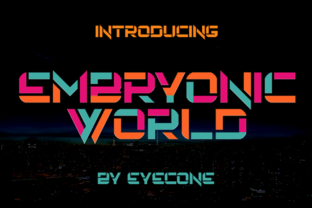
Embryonic World: A Creative Catalyst
Imagine a space where ideas don’t just form—they begin to breathe, pulse, and take tentative shape. That’s the essence of Embryonic World: not a finished product or rigid framework, but a dynamic, generative environment designed to nurture early-stage thinking, collaboration, and experimentation. It’s especially valuable for professionals who routinely navigate ambiguity—whether you’re sketching a brand narrative, prototyping a learning module, refining a service design, or mapping out a startup’s core value loop.
What Embryonic World Actually Is (and Isn’t)
Embryonic World isn’t software, a template library, or a certification program. It’s a conceptual and practical approach rooted in developmental thinking—the idea that meaningful work often emerges from loosely structured, iterative, sensory-rich exploration. Think of it as a mindset *and* a set of lightweight practices that prioritize emergence over prescription.
At its core, Embryonic World emphasizes three interlocking qualities:
- Low-fidelity fidelity: Prioritizing speed and adaptability over polish—using hand-drawn flows, voice memos, physical mood boards, or live-collaborative whiteboards instead of pixel-perfect mockups in early stages.
- Contextual anchoring: Grounding abstract concepts in real human behaviors, constraints, and environments—not hypothetical users, but observed patterns from interviews, field notes, or analytics outliers.
- Generative friction: Introducing intentional, light constraints—like time-boxed ideation sprints, forced analog tools, or cross-disciplinary pairing—to spark unexpected connections rather than defaulting to familiar solutions.
This isn’t about avoiding structure—it’s about delaying premature optimization. Teams using Embryonic World report spending up to 40% less time revisiting foundational assumptions later in projects because early alignment was built on shared observation, not isolated speculation.
Where It Adds Real Value
Embryonic World shines brightest where outcomes are uncertain and stakes demand thoughtful iteration—not perfection on day one.
For Educators & Curriculum Designers
A high school science teacher used Embryonic World principles to co-design a climate literacy unit with students. Instead of starting with learning objectives, they began with raw local data—water quality reports, neighborhood heat maps, oral histories from long-time residents. Students sketched speculative “what if” interventions on large paper rolls, then tested them against real constraints (budget, policy, feasibility). The resulting unit wasn’t just academically rigorous—it carried emotional resonance and civic texture because it grew *from* their context, not *onto* it.
For Marketers & Brand Strategists
One B2B SaaS team replaced their traditional brand audit with an Embryonic World sprint: they gathered unedited customer support transcripts, sales call recordings (with consent), and social comments—not to extract quotes, but to map emotional cadence and recurring metaphors (“It’s like trying to assemble IKEA furniture without the manual”). From those raw inputs, they built a living brand lexicon that guided tone, visual hierarchy, and even feature naming—not as a static style guide, but as an evolving reference point tied directly to how people actually speak and struggle.
For Freelancers & Solopreneurs
When launching a new service offering, many freelancers default to competitive analysis and polished landing pages. Those who apply Embryonic World start smaller: they host three no-agenda coffee chats with past clients, ask only “What felt *almost* right—but not quite?” and document responses verbatim. They then distill patterns into simple visual anchors—a color swatch representing a recurring feeling, a single line drawing capturing a workflow bottleneck. These become the north stars for messaging, pricing models, and even contract language—ensuring the offer solves for lived experience, not imagined demand.
Practical Considerations Before You Begin
Embryonic World isn’t universally suited to every scenario—and that’s by design. Here’s what to weigh before adopting it:
- Stakeholder readiness matters more than tools. If your client or leadership expects linear deliverables (e.g., “Phase 1: Strategy Deck, Phase 2: Visual Identity”), introduce Embryonic World incrementally—frame early outputs as “shared sense-making artifacts,” not final assets.
- Time investment is front-loaded—but pays compound interest. Expect to spend 2–3 hours gathering raw inputs (recordings, photos, field notes) before any synthesis begins. That upfront effort reduces rework cycles later, but requires buy-in to pause execution briefly.
- Digital tools can support—but shouldn’t replace—tactile grounding. Miro or FigJam work well *if* used to mirror physical processes (e.g., sticky-note clustering, timed silent sketching). Avoid jumping straight into AI-generated mood boards or auto-synthesized insights—those skip the essential human filtering step Embryonic World relies on.
- It thrives with diversity—not consensus. The goal isn’t group agreement in early stages; it’s surfacing divergent interpretations of the same raw material. Encourage participants to annotate the same photo with different lenses: “What does this reveal about power?” “Where is the friction hidden?” “What’s unsaid here?”
Getting Started Without Overcomplicating It
You don’t need training or licensing to begin. Try this in your next project kickoff:
- Gather one unfiltered artifact: a 90-second voice memo from a recent user, a screenshot of a confusing checkout flow, or a photo of a cluttered workspace.
- Print it (yes, physically) or project it large. No annotations yet—just observe silently for 60 seconds.
- Each person writes *three concrete observations* on sticky notes—no interpretations, just what’s visible or audible (“The ‘Submit’ button is 12px tall,” “They paused for 4.2 seconds before saying ‘I guess?’”).
- Cluster notes by pattern—not by person. What repeats? What contradicts? Where do gaps appear?
- Ask: “What’s the smallest, most human-scale question this raises?” Not “How do we fix it?” but “What would make someone feel safe enough to try again?”
That’s Embryonic World in motion: grounded, collaborative, and quietly powerful. It doesn’t promise faster launches—but it does increase the odds that what you launch matters, resonates, and evolves with integrity.
Embryonic World won’t replace your project management tool or design system. But when used intentionally, it reshapes how you define “ready”—shifting focus from completion to cultivation. And in a world saturated with polished surfaces, that kind of depth is increasingly rare—and increasingly valuable.